Contemporary Asian Portrait Art 1900s Museum Asian Portrait Art 1900s Museum
Collection Highlights
figure
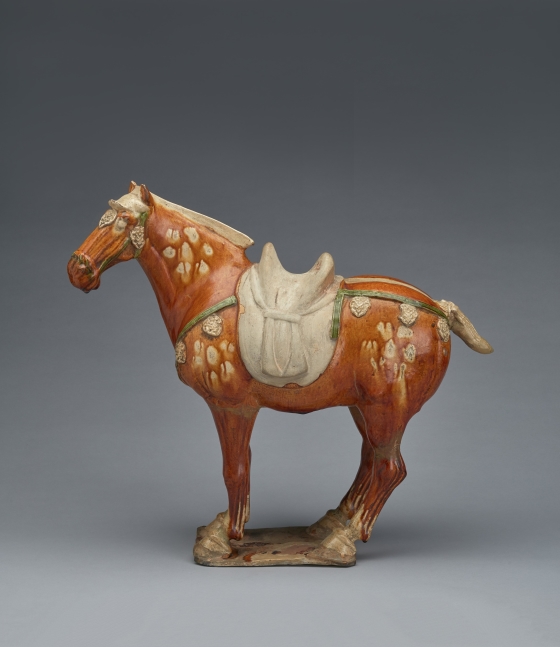
Bridled and Saddled Equus caballus
600s–700s, Tang dynasty (618–907)
Mainland china
Earthenware
Bequest of Bernadette Berger
2017.43
With its orange-glazed trunk, the accenting detail of a bright green bridle, and its foam-colored patches, mane, and tail, this robust horse displays the three-color (sancai) glaze combination associated with archetype Tang dynasty sculpture. With increasing connections between China and Persia and Westward Asia in the early Tang dynasty, a sizable number of tall, powerful horses were brought to China. They were profoundly admired by the Tang court and the aristocracy, and ceramic horses from this menstruation were modeled on these imported horses.
Horse, 600s–700s. Tang dynasty (618–907), China.
Glazed earthenware; 20 ten 7 one/2 ten 21 in.
Denver Art Museum: Heritance of Bernadette Berger, 2017.43
canteen, pilgrim
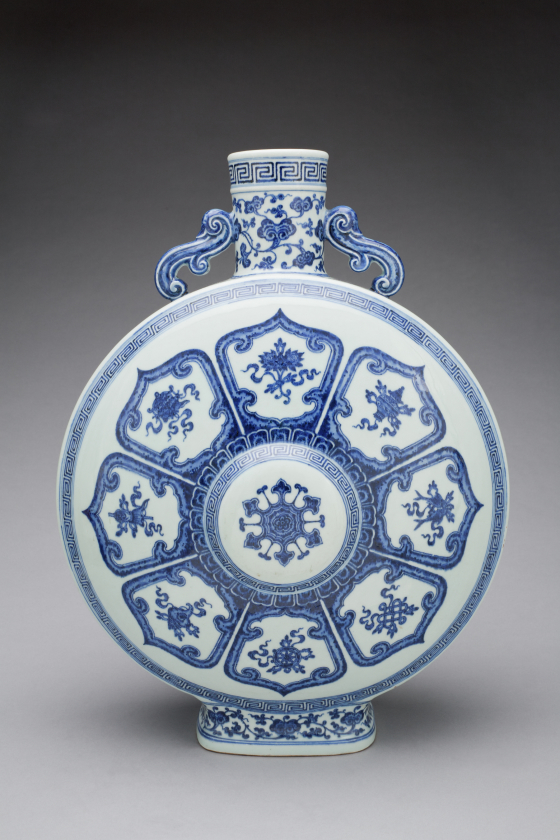
Moon Flask
1736–1795, Qianlong menstruation, Qing dynasty (1644– 1911)
People's republic of china
Porcelain
Souvenir of May Wilfley in retentivity of her parents, A. R. Wilfley and Addie Chiliad. Wilfley
1974.28
With a circular torso, tube-shaped neck, and a flared oval base, this blue-and-white moon flask is one of the finest examples made during Emperor Qianlong'due south reign. It is decorated with Buddhist cheering signs and motifs, a popular practice since the Yuan dynasty (1279–1368). It is believed that these signs were introduced to inland China through the spread of esoteric Buddhism from Tibet. The shape of this flask is likely an faux of glass and metal vessels from Due west Asia.
Moon Flask, 1736–1795. Qianlong period, Qing dynasty (1644–1911), Prc.
Porcelain with underglaze blue; 19 1/2 x fifteen x viii in.
Denver Art Museum: Gift of May Wilfley in memory of her parents, A. R. Wilfley and Addie M. Wilfley, 1974.28
effigy
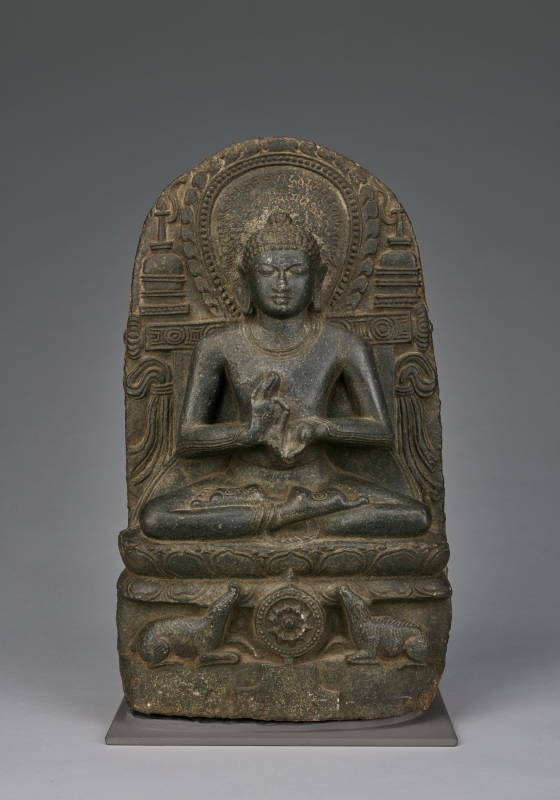
Buddha
800s-900s, Pala dynasty
India
Stone
Gift of Irene Littledale Downs
1972.227
This carving hither of the Buddha shares characteristics of Pala catamenia sculpture: the double lotus base on which the figure sits, the crossbar throne-back, and the upside-downward horsheshoe-shaped halo. The Buddha's hair is in snail-shell curls and the protuberance (ushnisha) on his head shows his aware land. The ii deer on the base of operations refer to the deer park where the Buddha taught his start sermon, and the bicycle symbolizes this first didactics, when the Buddha gear up the wheel of law in motion.
. figure. 9th century-tenth century. Gift of Irene Littledale Downs. 1972.227.
Fugai Ekun
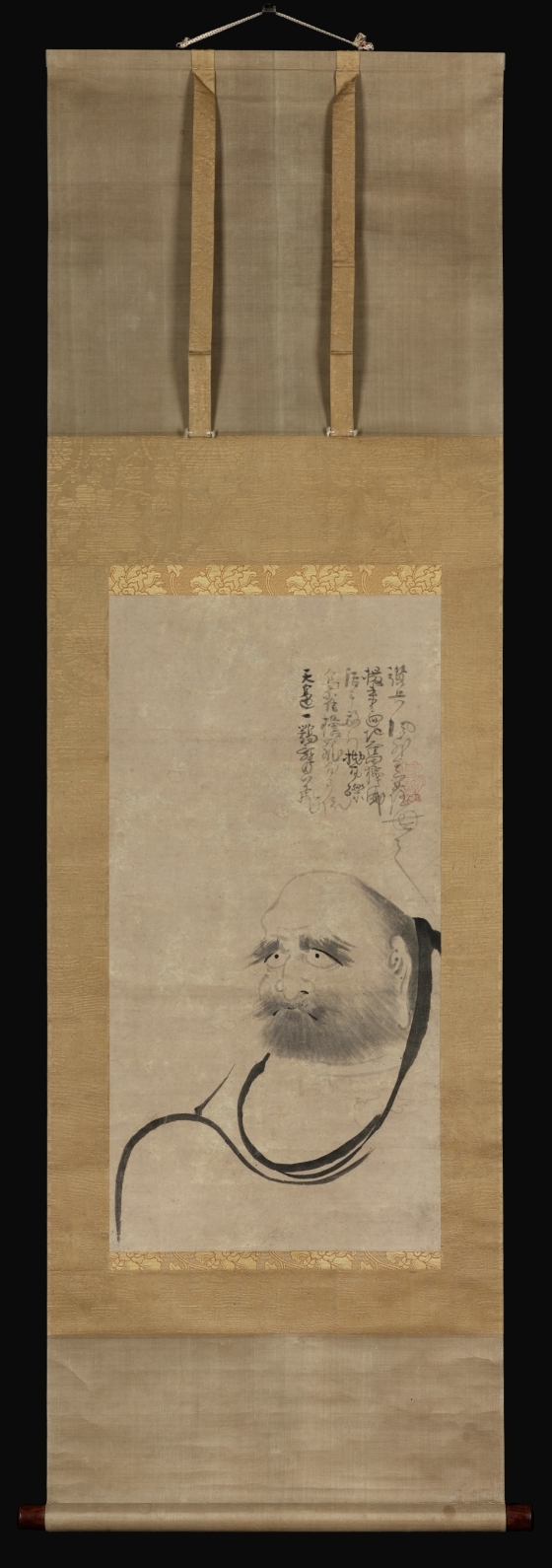
Daruma
Fūgai Ekun
Japanese, 1568–1654
Bodhidharma
1600s, Edo flow (1615–1868)
Ink and colour on silk
Souvenir of Mr. and Mrs. John B. Bunker
1982.135
Bodhidharma (known in Japan as Daruma) is the S Indian monk who introduced the Zen school of Buddhism (Chinese: Chan) to Communist china in the 6th century. From the late sixteenth century, exaggerated caricatures of Daruma became a frequent field of study among Japanese painters. Daruma's piercing gaze in this painting is a reference to an account that Daruma sat meditating for nine years, staring at a cavern wall with wide-open up optics. The creative person of this work, Fūgai Ekun, was nicknamed Ana (Cave) Fūgai because he spent many years living in mountainside caves, perchance in emulation of Daruma.
Fugai Ekun (Japanese). Daruma. 1600s. Gift of Mr. and Mrs. John B. Bunker. 1982.135.
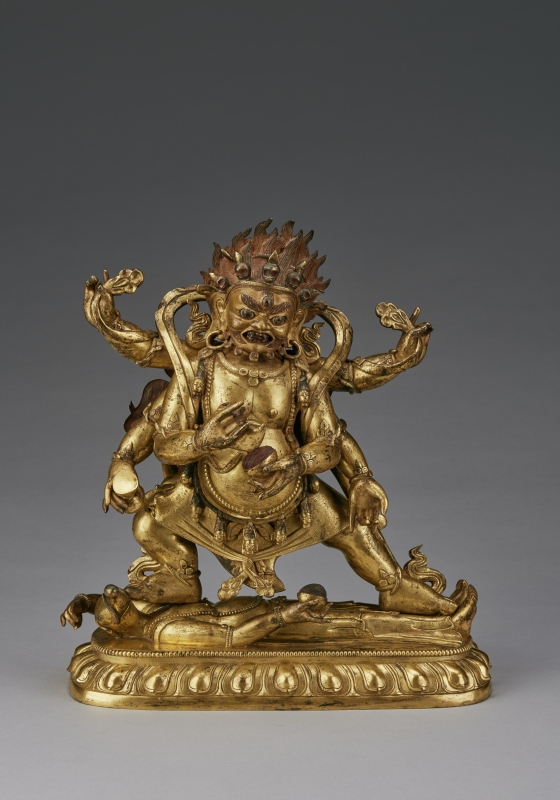
Lord of the Faith-Guarding Deities (Mahakala)
Lord of the Faith-Guarding Deities (Mahakala)
Tibet
1700s
Brass
Walter C. Mead Collection
1933.14
Mahakala, the Great Black One, is the nearly popular of the protectors of Tibetan Buddhism, and is often plant at the inner entrance of a temple or at his own special shrine. Hither he appears in his six-armed manifestation, clothed in an elephant hide and a tiger pelt, trampling the prone elephant-headed effigy of Ganesha. His fierce countenance is reinforced past his flame-like hair, a crown and a garland of skulls, and the vajra chopper and skull loving cup that he holds in his heart hands. Traces remain of a red paint that once highlighted these features.
. Lord of the Faith-Guarding Deities (Mahakala). 18th century. brass. Walter C. Mead Collection. 1933.xiv.
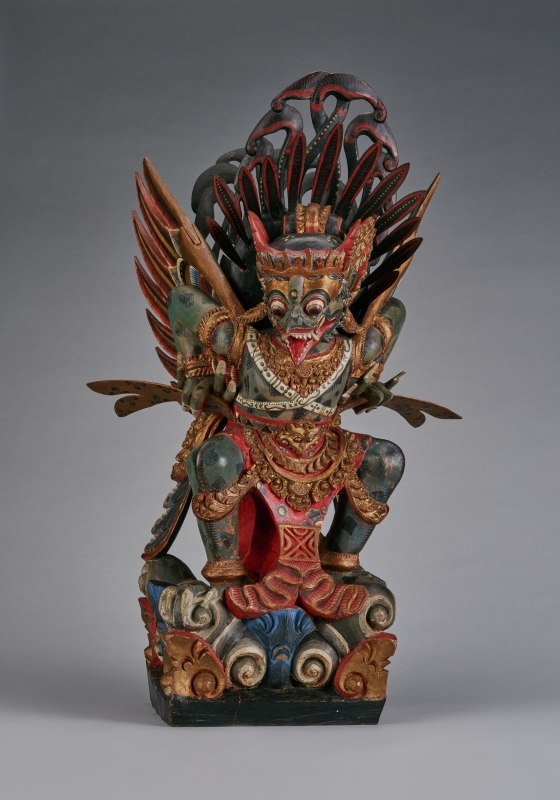
figure
Garuda (Vehicle of Vishnu)
Indonesia, Bali
1800s
Polychromed forest
Museum purchase for the Frederic H. Douglas Collection
1956.8
For centuries, trade and the spread of Indian religious practices allowed Hinduism to make a lasting impression upon the people of Bali. Although afterward Arab traders brought Islam to Indonesia, to this mean solar day the island of Bali remains primarily Hindu. Garuda, the half-man/half-eagle vehicle associated with the Hindu god Vishnu, is an especially pop effigy who is believed to ward off snakes. Ornately carved and decorated images of this type were often placed in the rafters of open-air pavilions and palaces. This well-preserved sculpture provides an idea of what these figures may have looked like before their color disappeared due to neglect and the passing of fourth dimension
Image of Garuda, virtually 1875. Bali, Indonesia. Polychromed forest; 29 x 18 x 17 1/4 in.
Denver Art Museum: Buy for the Frederic H. Douglas Drove, 1956.eight
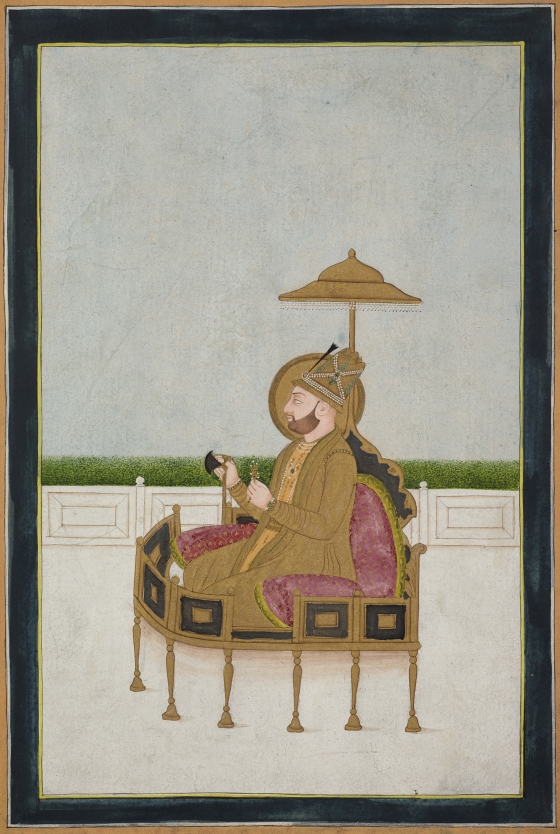
Portrait of Nadir Shah
Nadir Shah Seated on Throne
Nigh 1760, Mughal dynasty (1526–1857)
Delhi or possibly Jaipur, India
Opaque watercolor and gold on paper
Gift of the Edna Hadley Collection
1968.9
The Persian ruler Nadir Shah (reigned 1736–1747) led a successful invasion of India in 1739, defeating the Mughal ruler Muhammad Shah at the boxing of Karnal. In this painting, Nadir Shah wears a Farsi coat and conical headdress, both of which adjure to his foreign origin. This portrait, forth with many others from the same period, may have been commissioned by Nadir Shah to memorialize his victory.
. Portrait of Nadir Shah. c. 1760. Gift of the Edna Hadley Collection. 1968.9.
Encounter more Asian art
Browse objects from the Asian Art collection in our online collection.
Publications
Fantastic Brush: Twentieth-Century Chinese Ink Art from the Robert and Lisa Kessler Collection. Denver Fine art Museum, 2021. ISBN: 978-one-945483-05-ix
Linking Asia: Art, Trade and Devotion. Denver Art Museum, 2017. ISBN 978-0914738-53-4.
From the Fire: Contemporary Japanese Ceramics from the Robert and Lisa Kessler Collection. Denver Art Museum, 2016. ISBN 978-0914738-42-3.
Membership and Museum Friends
Membership at the Denver Art Museum not only provides you lot discounts and access, but also the satisfaction of knowing your support helps us preserve and share art with nowadays and future generations. Become a member today and see just how much the museum has to offer!
Are y'all interested in a specific type of art, while besides enjoying opportunities to participate beyond the museum? If and then, consider deepening your support by adding Museum Friends to your membership. Museum Friends bask access to free lectures, a deeper dive into a department of interest, and invitations to social gatherings for that department of interest.
The Martin Building Project
The gallery for this drove is housed inside the newly renovated Martin Building. Standing seven stories tall, the Martin Edifice is habitation to collection galleries, a conservation laboratory, interactive classroom infinite, a family activity centre, two restaurants, and the make new Anna and John J. Sie Welcome Center. Information technology reopened to the public on October 24, 2021.
Source: https://www.denverartmuseum.org/en/collection/asian-art
0 Response to "Contemporary Asian Portrait Art 1900s Museum Asian Portrait Art 1900s Museum"
Post a Comment