Innerracial Couple With Baby Should.baby Learn Both Languages
Any adult who has attempted to learn a foreign language can attest to how difficult and confusing it can be. So when a three-twelvemonth-old growing upwardly in a bilingual household inserts Castilian words into his English sentences, conventional wisdom assumes that he is confusing the two languages.
Research shows that this is non the case.
In fact, early childhood is the all-time possible time to learn a second language. Children who feel two languages from birth typically go native speakers of both, while adults often struggle with second language learning and rarely attain native-like fluency.
But the question remains: is it disruptive for babies to learn 2 languages simultaneously?
When do babies learn language?
Research shows babies begin to learn language sounds earlier they're fifty-fifty built-in. In the womb, a mother'southward voice is one of the about prominent sounds an unborn babe hears. Past the time they're born, newborns can not only tell the divergence between their mother'southward linguistic communication and another language, simply also bear witness a capability of distinguishing between languages.
Language learning depends on the processing of sounds. All the world's languages put together comprise about 800 or so sounds. Each language uses simply almost 40 language sounds, or "phonemes," which distinguish one language from another.
At birth, the babe brain has an unusual souvenir: it can tell the departure between all 800 sounds. This means that at this stage infants can learn any linguistic communication that they're exposed to. Gradually babies effigy out which sounds they are hearing the most.
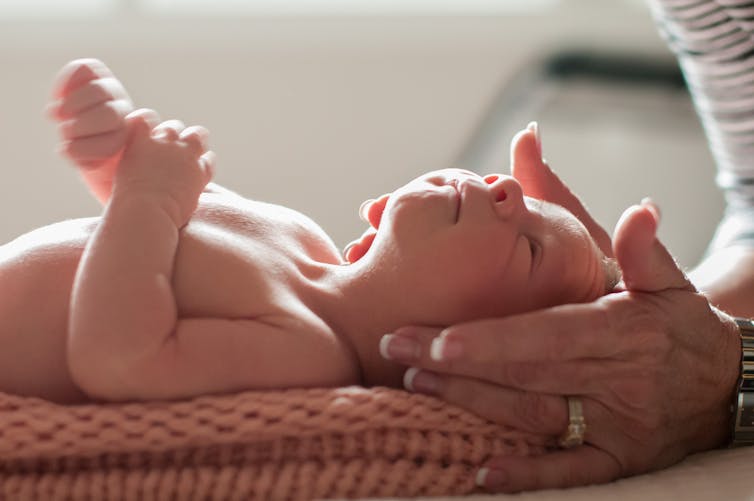
Between 6 and 12 months, infants who grow up in monolingual households get more specialized in the subset of sounds in their native language. In other words, they become "native language specialists." And, by their first birthdays, monolingual infants brainstorm to lose their ability to hear the differences betwixt foreign language sounds.
Studying babe brains
What most those babies who hear two languages from birth? Tin can a infant brain specialize in two languages? If then, how is this process different so specializing in a single language?
Knowing how the baby brain learns ane versus two languages is important for understanding the developmental milestones in learning to speak. For case, parents of bilingual children often wonder what is and isn't typical or expected, or how their child will differ from those children who are learning a single language.
My collaborators and I recently studied the brain processing of linguistic communication sounds in 11-month-one-time babies from monolingual (English only) and bilingual (Spanish-English) homes. We used a completely noninvasive engineering called magnetoencephalography (1000000), which precisely pinpointed the timing and the location of activity in the encephalon as the babies listened to Spanish and English syllables.
We establish some key differences between infants raised in monolingual versus bilingual homes.
At 11 months of historic period, just before nigh babies begin to say their kickoff words, the brain recordings revealed that:
-
Babies from monolingual English households are specialized to procedure the sounds of English, and not the sounds of Spanish, an unfamiliar language
-
Babies from bilingual Castilian-English language households are specialized to process the sounds of both languages, Spanish and English.
Our findings prove that babies' brains go tuned to whatever language or languages they hear from their caregivers. A monolingual brain becomes tuned to the sounds of one language, and a bilingual brain becomes tuned to the sounds of two languages. By 11 months of age, the activity in the baby brain reflects the language or languages that they have been exposed to.
Is it OK to larn two languages?
This has of import implications. Parents of monolingual and bilingual children alike are eager for their little ones to utter the first words. Information technology's an exciting time to larn more about what the babe is thinking. Nonetheless, a common concern, especially for bilingual parents, is that their kid is not learning fast enough.
Nosotros institute that the bilingual babies showed an equally potent brain response to English sounds as the monolingual babies. This suggests that bilingual babies were learning English language at the same rate equally the monolingual babies.
Parents of bilingual children also worry that their children will not know as many words equally children who are raised with one language.
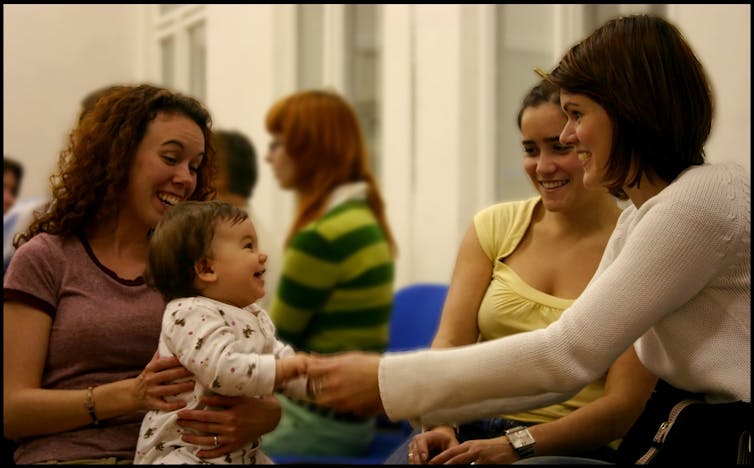
To some extent, this business is valid. Bilingual infants split up their time between two languages, and thus, on boilerplate, hear fewer words in each. However, studies consistently show that bilingual children do not lag backside when both languages are considered.
Vocabulary sizes of bilingual children, when combined across both languages, accept been constitute to be equal to or greater than those of monolingual children.
Another common concern is that bilingualism causes confusion. Part of this business arises due to "code switching," a speaking behavior in which bilinguals combine both languages.
For example, my four-year-old son, who speaks English, Spanish, and Slovenian, goes as far as using the Slovenian endings on Spanish and English language words. Inquiry shows bilingual children code-switch because bilingual adults effectually them do too. Code-switching in bilingual adults and children is dominion-governed, not haphazard.
Unlike monolingual children, bilingual children take some other language from which they tin can hands infringe if they tin't speedily call up the appropriate discussion in one linguistic communication. Even two-yr-olds modulate their language to match the linguistic communication used by their interlocutor.
Researchers have shown code switching to be part of a bilingual child'south normal language development. And information technology could even be the beginning of what gives them the extra cognitive prowess known every bit the "bilingual advantage."
Bilingual kids are at an reward
The good news is young children all around the world can and do acquire two languages simultaneously. In fact, in many parts of the world, being bilingual is the norm rather than an exception.
It is at present understood that the constant need to shift attention between languages leads to several cognitive advantages. Enquiry has plant that bilingual adults and children testify an improved executive functioning of the encephalon – that is, they are able to shift attention, switch between tasks and solve problems more hands. Bilinguals have too been found to have increased metalinguistic skills (the ability to think about language per se, and empathise how it works). There is evidence that beingness bilingual makes the learning of a third linguistic communication easier. Further, the accumulating effect of dual language experience is thought to interpret into protective effects against cerebral refuse with crumbling and the onset of Alzheimer's disease.
So, if you want your child to know more than 1 linguistic communication, it's best to kickoff at an early age, before she even starts speaking her starting time language. It won't confuse your child, and it could even give her a heave in other forms of cognition.
Source: https://theconversation.com/why-the-baby-brain-can-learn-two-languages-at-the-same-time-57470
0 Response to "Innerracial Couple With Baby Should.baby Learn Both Languages"
Post a Comment